Worklets & Threading
Model compilation, tensor allocation, and neural network inference are synchronous, compute-intensive native operations. Running them directly on the React Native JavaScript thread blocks UI rendering and touch handling.
To keep the UI responsive, React Native ExecuTorch integrates with react-native-worklets, allowing synchronous native code to execute across secondary threads and worklet runtimes.
The 'worklet' Directive
A worklet runtime is an isolated JavaScript environment running on a dedicated thread. Adding the 'worklet' directive at the top of a function marks it as dispatchable to any worklet runtime.
All core primitives, methods, and native operations in this library include the 'worklet' directive out of the box — including loadModel, model.execute, tensor, and namespaces like math and cv. When creating custom preprocessing or pipeline helpers, add the 'worklet' directive so they can run off-thread without additional wrappers.
Execution Contexts
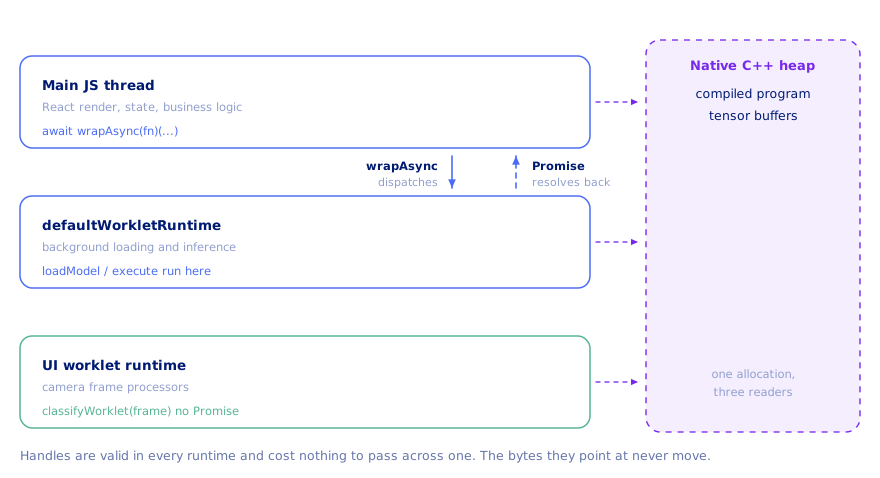
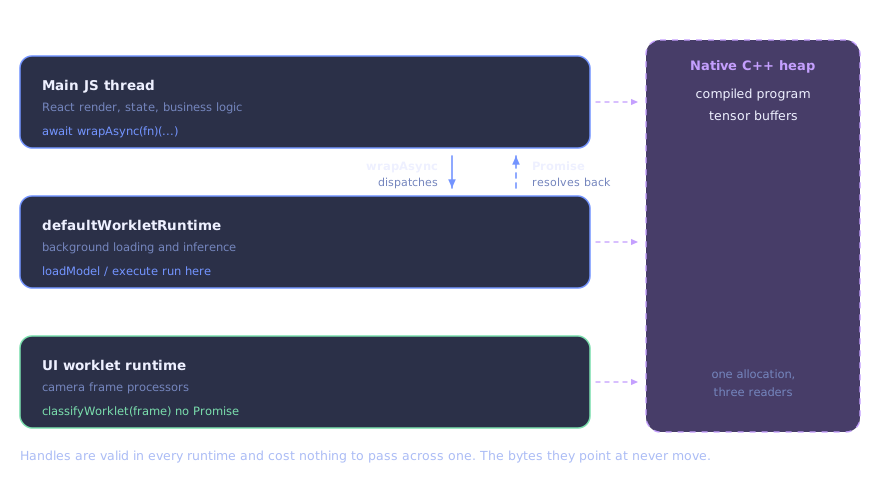
In a React Native app with ExecuTorch, code executes across three distinct environments:
| Context | Role | How to Call ExecuTorch |
|---|---|---|
| Main JS Thread | React component rendering, state management, and business logic. | Offload synchronous operations using wrapAsync. |
| Background Worklet Runtime | Asynchronous model loading and background inference. | Targets the library's pre-configured defaultWorkletRuntime (or a custom runtime) via wrapAsync. |
| UI Worklet Runtime | Per-frame video processing (e.g. VisionCamera frame processors) running on the UI/render thread. | Invoke synchronous 'worklet' functions directly without await or promise overhead. |
Offloading Work with wrapAsync
wrapAsync(fn, runtime?) converts a synchronous worklet function into a Promise-based asynchronous function. Calling the wrapped function dispatches fn to the target runtime, executes it, and resolves on the JS thread with the returned value.
import { loadModel, wrapAsync } from 'react-native-executorch';

// loadModel is synchronous; wrapAsync dispatches it to a background thread
const model = await wrapAsync(loadModel)('/path/to/model.pte');
If the runtime parameter is omitted, wrapAsync targets defaultWorkletRuntime — a background thread created automatically by the library. You can also pass a custom runtime created with createWorkletRuntime from react-native-worklets for isolated workloads.
Error Propagation Across Runtimes
When a function running inside a worklet throws an error,
wrapAsync intercepts the
serialized exception and reconstructs it on the JS thread as an
RnExecuTorchError. This
preserves the original error
code and
diagnostics across the thread boundary. See Error Handling
for details on narrowing these errors.
Sharing Models and Tensors Across Threads
Tensor and Model are JSI host objects holding pointers to native C++ allocations. Because their underlying data resides in native memory rather than the JS garbage collector heap, handles can be passed across runtimes with zero copying:
- You can load a model once on a background runtime via
wrapAsync(loadModel), and immediately pass the handle to a UI worklet. - Native mutexes ensure safety: executing a model from multiple threads
concurrently fails immediately with
RESOURCE_BUSYrather than corrupting memory.
For complete guarantees, see Thread Safety.
The Dual-API Pattern
High-level pipelines often need to support both async calls from React components (on the JS thread) and synchronous execution in high-throughput loops (like camera frame processors on a UI worklet). To accommodate both, pipelines expose dual interfaces:
import { loadModel, tensor, wrapAsync } from 'react-native-executorch';
import type { WorkletRuntime } from 'react-native-worklets';

export async function createClassifier(modelPath: string, runtime?: WorkletRuntime) {
  const model = await wrapAsync(loadModel, runtime)(modelPath);

  const tInput = tensor('float32', [1, 3, 224, 224]);
  const tOutput = tensor('float32', [1, 1000]);

  // Synchronous worklet: call directly inside frame processors / worklet runtimes
  const classifyWorklet = (input: Float32Array) => {
    'worklet';
    tInput.setData(input);
    model.execute('forward', [tInput], [tOutput]);
    return tOutput.getData(new Float32Array(tOutput.numel));
  };

  return {
    // 1. Synchronous execution for worklets (zero promise overhead)
    classifyWorklet,
    // 2. Async execution for the JS thread
    classify: wrapAsync(classifyWorklet, runtime),
    // Resource cleanup
    dispose: () => {
      tInput.dispose();
      tOutput.dispose();
      model.dispose();
    },
  };
}
Next Steps
- Models & Tensors — Memory model, lifecycle management, and native tensor operations.
- Operations & Utilities — Native preprocessing (
cv,math,speech) compatible with worklets. - Error Handling — Safe error handling across runtime boundaries.