Serializable
Serializable is a type of shared memory that holds an immutable value that can be serialized and deserialized across different JavaScript Runtimes. It allows passing JavaScript values between Runtimes while ensuring that the data is correctly transferred and reconstructed. The reference cannot be manipulated, as it doesn't represent any standard JavaScript object.
You can't pass JavaScript values to other Runtimes without prior serialization.
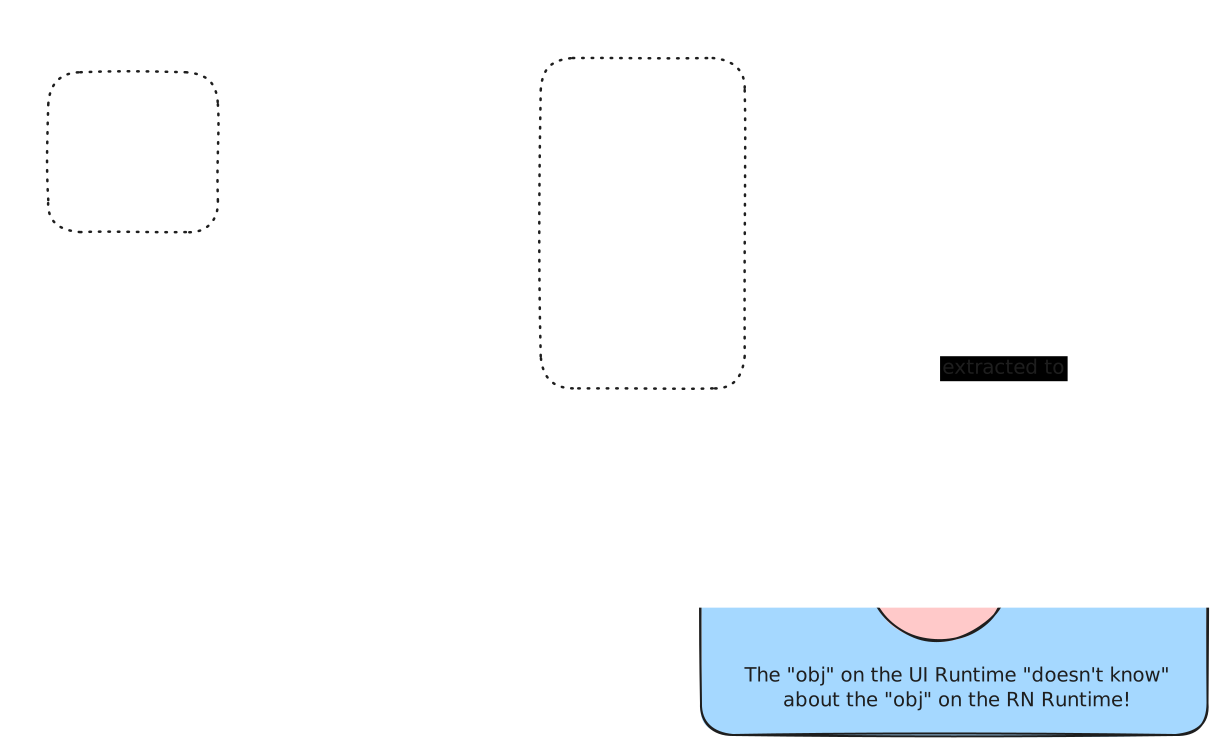
Serializable memory model


Type definitions
type SerializableRef<TValue = unknown> = {
  __serializableRef: true;
  __nativeStateSerializableJSRef: TValue;
};
Passing a copy
First, createSerializable(settings) creates an immutable serialized representation of the object in native memory and returns an opaque reference. Passing that reference to scheduleOnUI reconstructs the value as a JavaScript object on UI.
Code
Colours connect each executing thread to its current code line. Recently executed lines fade over the next three ticks.
Console 0
No output yet
Watch the Serializable (immutable) appear in Shared native memory with { volume: 10 }. UI receives a JavaScript copy and changes it to { volume: 20 }, visible under its Globals. Both the Serializable and RN's original stay at { volume: 10 }.
The Serializable holds an immutable representation of the value; the JavaScript object reconstructed on UI is a separate, mutable copy. Changing that copy does not update the original object or the Serializable. This example stores each object on globalThis to make the two copies visible; globals themselves are not shared between runtimes.
Usually, you can pass the original value directly: scheduleOnUI(changeCopy, globalThis.settings). Scheduling functions automatically serialize their arguments. This example calls createSerializable explicitly to show the intermediate representation.
Supported types
| Type | Supported |
|---|---|
| string | yes |
| number | yes |
| boolean | yes |
| object | yes |
| array | yes |
| function (non-worklet) | yes |
| HostObject | yes |
| worklet | yes |
| Map | yes |
| Set | yes |
| ArrayBuffer | yes |
| RegExp | yes |
| Cyclic objects | no |
| Objects with custom prototype | no |
If you want to transfer objects with custom prototypes across Runtimes, you can use registerCustomSerializable to define your own serialization and deserialization logic.
Remarks
- The JavaScript value of a Serializable is a reference wrapper that only holds the C++ side in its
jsi::NativeState. - The prop
__nativeStateSerializableJSRefpresent on the reference doesn't exist in runtime - it's only a TypeScript definition to tell you what type of value is held by the Serializable. - Functions that aren't worklet functions are serialized as references to function instances on the respective Runtime, meaning that they can't be invoked on other runtimes, only passed around.