Sharing memory
Worklets let you run JavaScript on more than one thread. The moment you do that, you have to answer a question that single-threaded JavaScript has always let you ignore: how do two pieces of code, running at the same time, look at the same data?
This page explains why that question has no cheap answer in JavaScript, and why Worklets expose three distinct shared memory primitives — the Serializable, the Synchronizable, and the Shareable — instead of one.
JavaScript is single-threaded on purpose
JavaScript is designed around a single-threaded execution model. One call stack, one event loop, one piece of code running at a time, all neatly packed into an abstraction called the JavaScript Virtual Machine — JSVM, which we'll call a "Runtime" from here on. That choice is load-bearing: it means a function that reads and mutates a variable cannot be interrupted halfway through by another function doing the same thing. There are no data races, no torn reads, no half-written objects. You never need a mutex to increment a counter.
The language leans on this guarantee everywhere. Closures capture variables by reference and expect those references to stay coherent. Objects are mutable, passed by reference, and shared freely across the program. None of this would be safe if two threads could touch the same heap at the same time — but in single-threaded JavaScript, it is safe by construction.
Parallelism and memory
So what exactly happens when we add another thread into the equation? The naive approach: just tell two threads to do some work on the same Runtime. They might work for a short while, but very soon we'll hit an EXC_BAD_ACCESS exception — at some point one thread is bound to change some underlying reference that the other thread assumes is stable.
The only thing we can do at this point is to give each thread its own Runtime. The crashes go away, everything runs in parallel, but we have a new problem: the two Runtimes are like two separate worlds.
For example, you can't just "hand" a JavaScript object from one Runtime to another. A JavaScript object is a collection of pointers into one specific engine's heap. Its prototype chain, its hidden class, its property storage or even the garbage collector or the global object — all of it is engine-internal state that another Runtime has no way to interpret. Force-interpreting such a collection of pointers in another Runtime would be like trying to read a pointer from one process and dereference it in another process — it just doesn't work. At this point, probably the simplest way of communicating and sharing data between these Runtimes is to connect via a WebSocket — but again, that's very naive.
How, then, do we share this data the right way — with the least overhead, in RAM, and preferably without unnecessary copies? It depends on the context and the kind of data we want to share.
Kinds of shared memory
We can categorize shared memory into three types, based on how they are implemented and how they behave across Runtimes:
Copy-only memory — Serializable
The simplest of them all: a way to move any value from Runtime A to Runtime B as-is — a number, an object, a string, essentially any value that can be expressed as data. However, changes to such a value on any Runtime aren't visible in the other Runtimes. Each Runtime is unaware that it has a copy and simply treats its value as the original. This is the Serializable primitive.
Each to-be-copied value is serialized into a byte stream and sent through C++ to the other Runtime, where it's reconstructed. This is straightforward for primitives like numbers and strings, but for objects it can be more complex — for example, how do you handle an object that contains a circular reference? Or a function? The implementation of the Serializable has to cover all these edge cases and at least produce a meaningful error when a value can't be serialized.
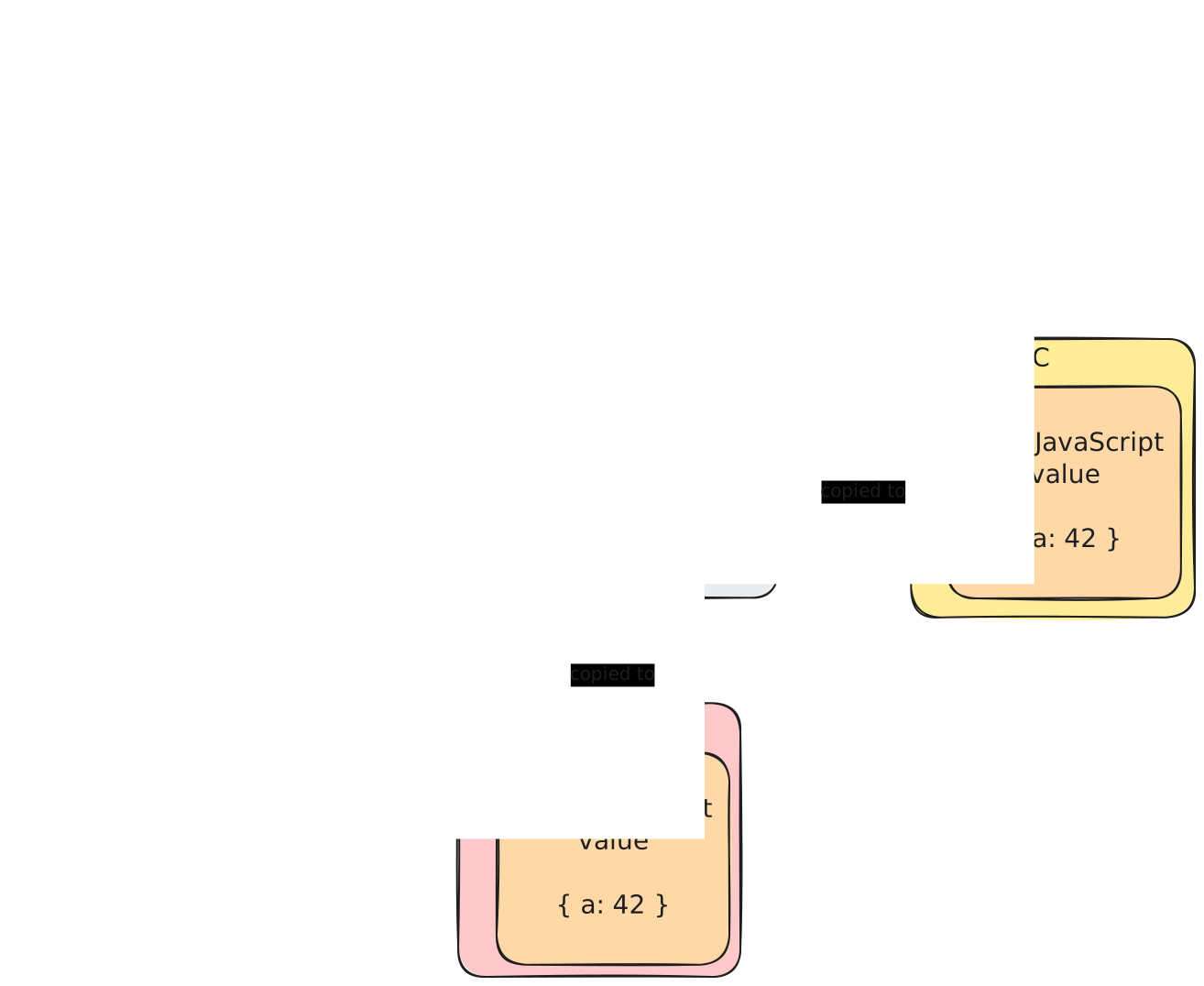
High-level overview of the Serializable memory model — no Runtime holds ownership of the value, they just exchange copies of it.
From the user's perspective, a Serializable is an opaque C++ value that Worklets know how to pass around and turn into regular JavaScript values on the other side. In all cases, this is done implicitly by the library APIs, and you never need to create Serializables directly.
Unbound memory — Synchronizable
The simpler type of memory that is actually shared — meaning that changes to it on Runtime A will be seen by Runtime B and all the other Runtimes — but not tied to any particular Runtime, unbound. This is achieved by keeping the actual "real" value outside of any Runtime, in C++, guarded by mutexes and other synchronization primitives. Each JavaScript Runtime holds just a specific kind of reference to the C++ value. Each read or write means crossing the boundary between JavaScript and C++. Because the memory is thread-safe, each Runtime can safely access it at its own discretion. This is the Synchronizable primitive.
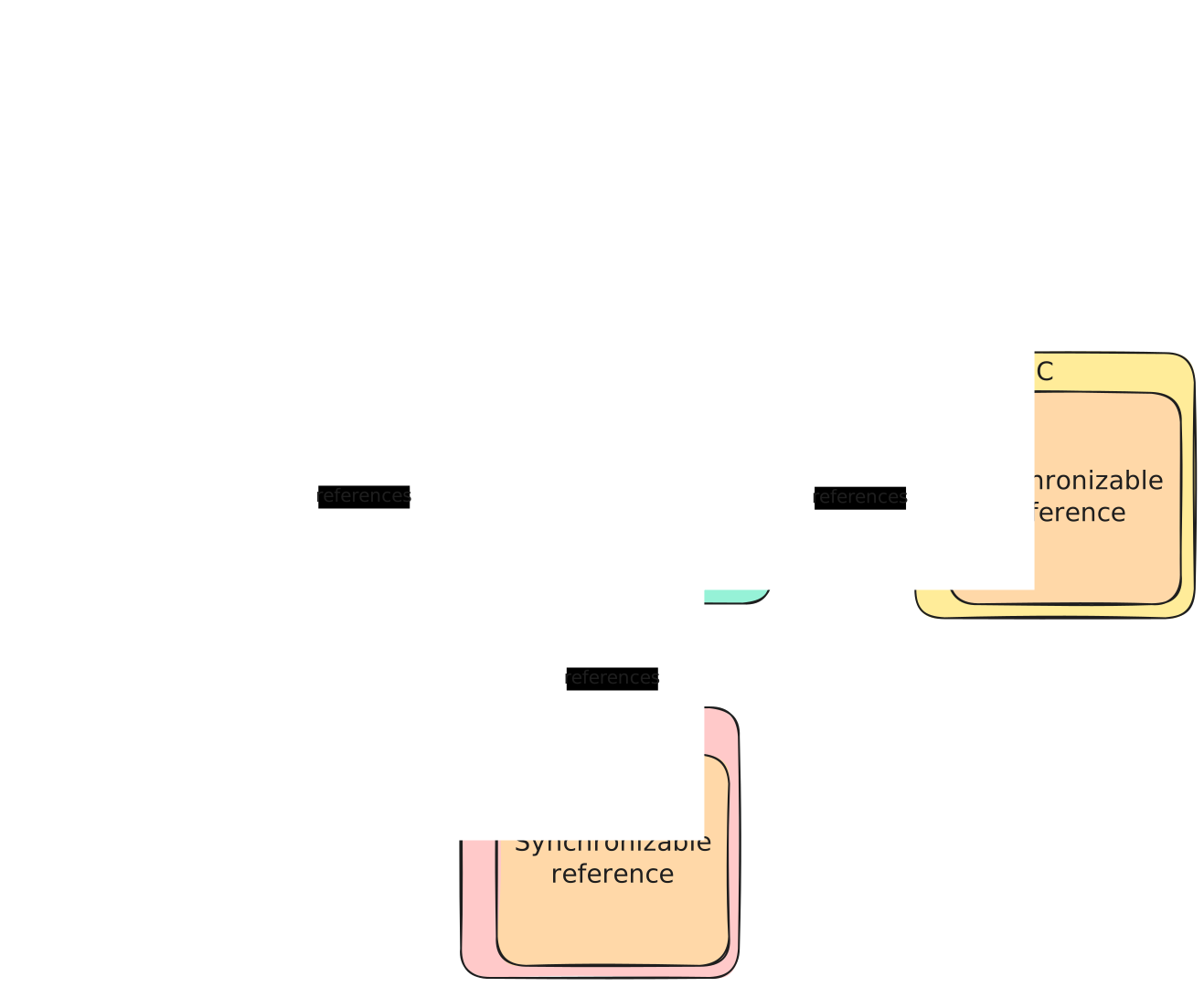
High-level overview of the Synchronizable memory model — the value is kept outside of any Runtime, and each Runtime holds a reference to it.
While it might seem like an ideal solution, the cost of keeping the value outside of a Runtime is significant. Each access to the Synchronizable means a round trip through C++ and conversions — because our Runtime can't just use the C++ type directly, the value has to be converted (to a Serializable) before it can be used in JavaScript. You're also severely limited in what you can do with the value — you can't store anything Runtime-specific in it, like a function or an object with a prototype chain, because it wouldn't make sense in another Runtime.
Bound memory — Shareable
This more complex type of shared memory overcomes some issues of unbound memory, but at the cost of being asymmetric and bound to a particular Runtime.
Operations on unbound memory are much more expensive than operations on plain JavaScript values, because each access has to cross the boundary between JavaScript and C++ via JSI. Runtime-bound memory optimizes access time on a single designated JavaScript Runtime, called the Host Runtime, by simply holding the value there as a plain JavaScript value. Other Runtimes, called Guest Runtimes, only have a specific kind of reference that "knows" that the actual value lives on another Runtime — if you want to access it with that reference, you must go to C++, lock the Host Runtime exclusively, read the actual value, and return it to the Guest Runtime that initiated the read. This is the Shareable primitive.
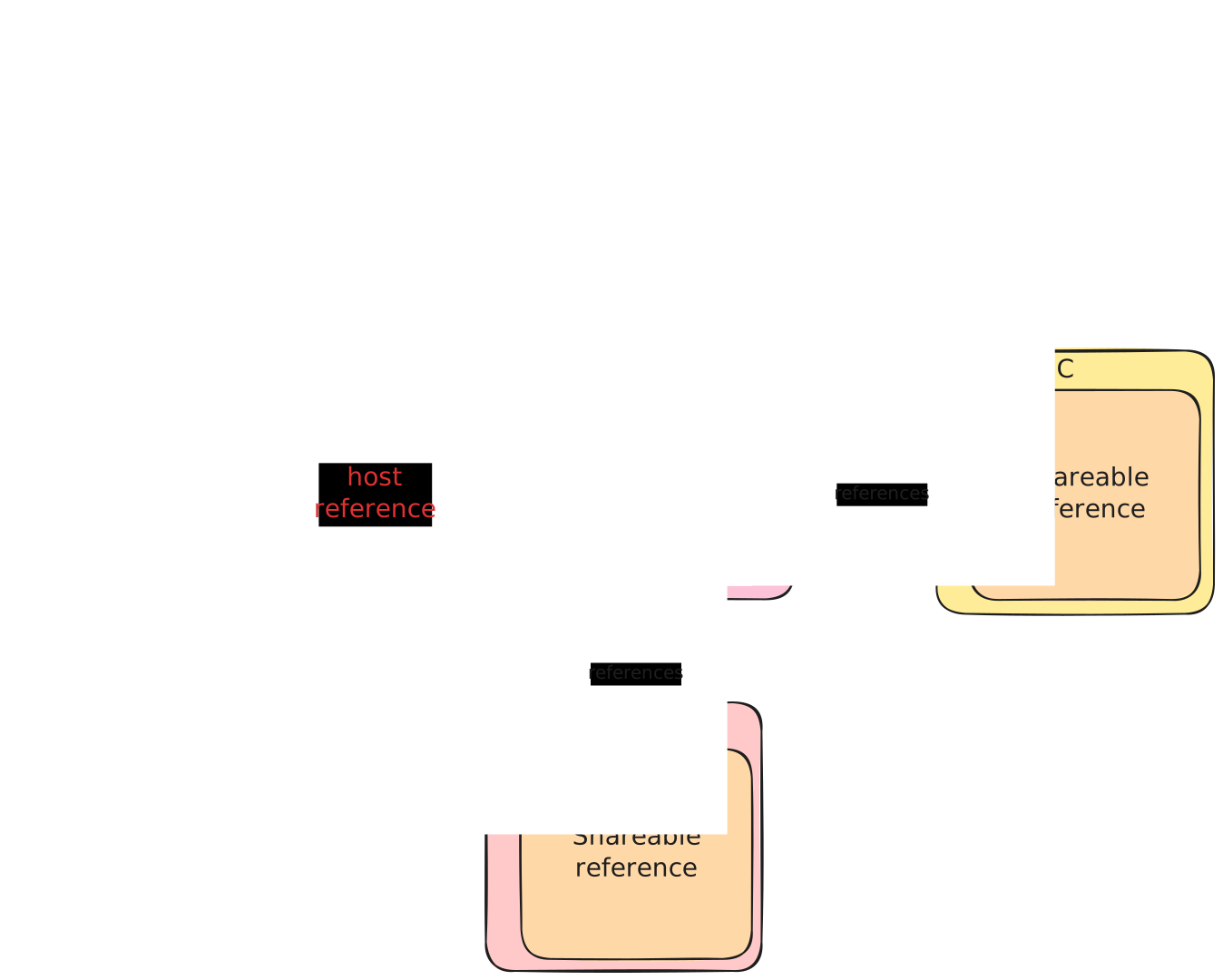
High-level overview of the Shareable memory model — the value is kept on the Host Runtime, and the Guest Runtimes hold a reference to it.
The Shareable should be the preferred way of handling non-trivial data sharing since it comes with the least overhead when used correctly. However, it requires a more careful design of your data flow and access patterns, to avoid too many round trips between the Guest Runtimes and the Host Runtime.
Choosing between them
Each of these primitives has its own use cases, and the right one to use depends on your specific needs. Here are some general guidelines:
- You are passing a value across Runtimes once, and the other side does not need to observe further changes. For
example, you want to pass a configuration object between Runtimes.
- Use a Serializable. Copy, pass and forget.
- You need a value that multiple Runtimes read and write with similar frequency, and you need them to see each other's
updates. For example, you want to keep your application state in a single place and have all Runtimes be able to
synchronize on it.
- Use a Synchronizable. Read and write only when you need to, maybe even add an event-emitting layer on top of it to avoid polling.
- One Runtime dominates access to the value, and other Runtimes only reach in occasionally. For example, you have an
animation engine that reads an animation state on every frame during a critical phase of the rendering pipeline, but
sometimes you want to change that state based on user input. Basically, you're writing Reanimated.
- Use a Shareable. Keep the value on the Host Runtime and let the Guest Runtimes read it when they need to, but limit the amount of reads and writes of the Guest to avoid too many round trips. Cache the value on the Guest Runtimes if you allow for eventual consistency.
The rest of this section documents each primitive in detail, along with the APIs — createSerializable, createSynchronizable, createShareable — for producing them.